

RocketLever™
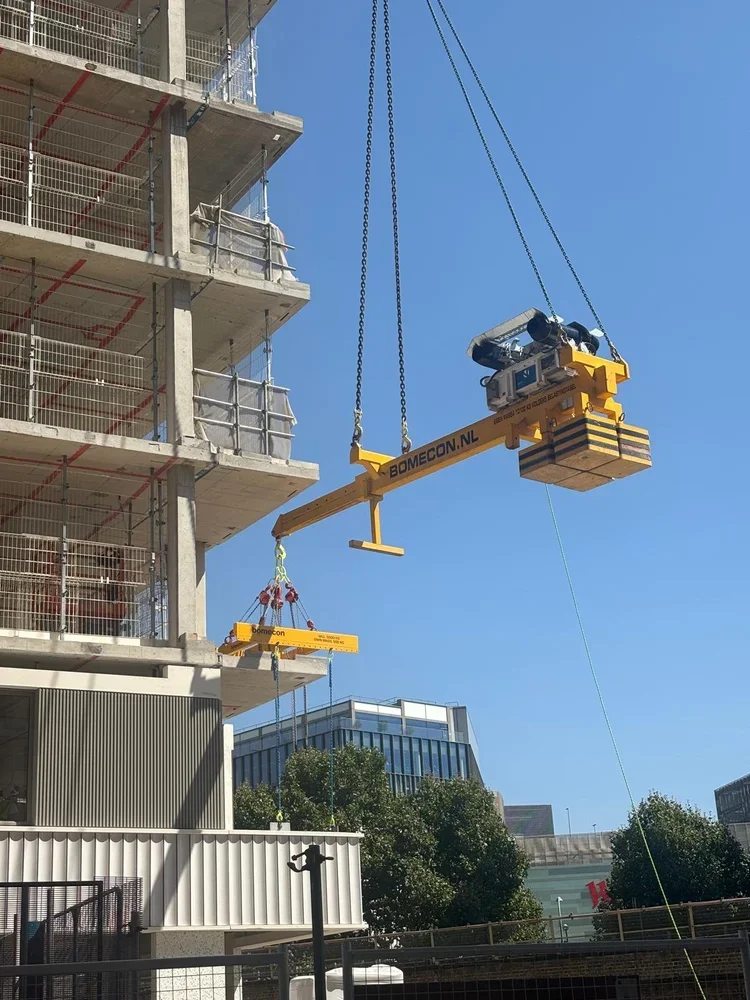
RocketLever combines an offset lifting arrangement with remotely controlled load-stabilisation technology to support precast installation beneath perimeter screens, slab overhangs and other restricted vertical access conditions.
The system is intended to help crews offset a suspended panel from the crane hook line, manoeuvre beneath an obstruction, control panel orientation remotely and reduce direct manual intervention near the load.
Lifting Beyond the Direct Hook Line
Perimeter protection screens, slab edges and structural overhangs can obstruct the crane’s direct vertical path. Where a precast panel must be positioned beneath or behind that obstruction, conventional vertical lifting geometry may not provide the required offset.
Manual control around the panel can also increase installation complexity and expose personnel to swing paths, pinch points and line-of-fire hazards. RocketLever is designed to support an engineered offset arrangement while remote load-control functions assist with panel orientation and stabilisation.
A Coordinated Offset and Load-Control Arrangement
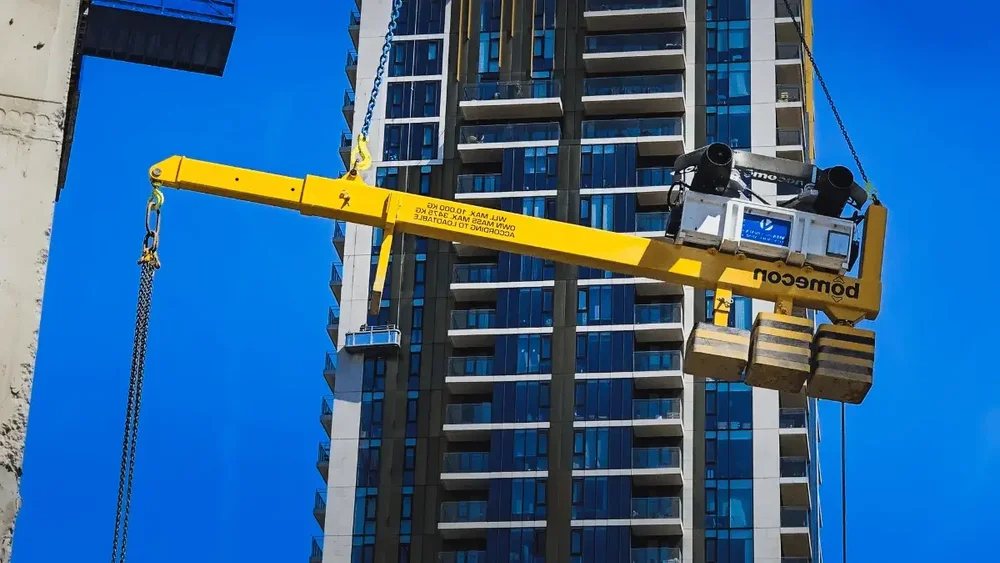
Developed through collaboration involving Thorp Precast, Bomecon and Vita Inclinata, RocketLever brings together an offset lifting beam or Maxi-Steker arrangement, configurable counterweight distribution, an integrated VLN load-control system and remote pendant operation.
-
01
Connect the Panel
The panel is connected using the approved engineered rigging and lifting-point arrangement.
-
02
Establish the Offset
The configured beam establishes the required relationship between the crane hook line and the suspended panel.
-
03
Present the Load
The crane presents the panel to the planned installation area under the approved lift methodology.
-
04
Control Orientation
The authorised remote operator commands panel rotation and uses assisted stabilisation as conditions permit.
-
05
Manoeuvre Past the Obstruction
The panel is manoeuvred beneath or beyond the obstruction while clearances and load behaviour are monitored.
-
06
Complete Placement
The installation crew completes positioning and connection in accordance with the engineered lift plan and site controls.
This high-level sequence is not a rigging instruction and does not replace engineering documentation, equipment instructions, lift planning or site procedures.
Configured for Controlled Precast Presentation
Each RocketLever arrangement must be selected and planned for the proposed panel, required offset, rigging geometry and installation sequence.
Configurable Weight Distribution
The beam and counterweight arrangement is configured to support the required lifting geometry and balance. Available capacity varies with reach and configuration.
Repeatable Angle Control
Stored orientation settings can support consistent panel presentation across repeated lifts, subject to load behaviour and operating conditions.
Active Rotational Assistance
Available system torque can help counter unwanted rotation and wind-influenced movement within approved operating conditions.
Remote Operating Position
The pendant allows an authorised operator to control relevant functions from an appropriate position with line of sight to the lift.
Specialised Offset Lifting Scenarios
RocketLever may be considered where conventional direct-hook geometry does not provide the required panel position or controlled presentation angle.
High-Rise Precast Façade Panels
Panels requiring planned orientation and controlled presentation at elevated installation zones.
Behind Perimeter Screens
Panels positioned beneath or behind perimeter protection systems that restrict the direct vertical path.
Offset from the Hook Line
Installations where the panel must be suspended away from the crane’s direct hook line.
Restricted Slab-Edge Installation
Placement zones with limited clearance around slab edges, screens or temporary structures.
Repeated Façade Sequences
Planned installation sequences that may benefit from repeatable panel orientation settings.
Controlled Presentation Angles
Precast elements that require a defined approach angle before final positioning and connection.
A Specialised Engineered Lifting Solution
RocketLever is not a general-purpose lifting accessory for automatic deployment. A proposed application requires review of the panel, lifting geometry, crane, rigging, obstruction and operating environment.
Early project information helps determine whether an appropriate configuration may support the intended methodology and what further engineering, documentation or trial work is required.
Initial Review Checklist
- Panel dimensions and mass
- Centre of gravity
- Required hook-line offset
- Perimeter-screen projection
- Installation opening and clearances
- Crane configuration and capacity
- Engineered lifting points
- Rigging and connection arrangement
- Site wind controls
- Installation sequence
- Storage, charging and handling requirements
- Operator competency and training
Indicative Configuration Data
The values below reflect the technical information retained from the supplied RocketLever page. Final capacity and performance depend on the selected arrangement and approved load table.
- Maximum Working Load Limit
- Up to 10 tonnes According to the applicable load table; varies with reach and counterweight configuration.
- Available Counter-Torque
- Up to 1,400 N·m Configuration and operating-condition dependent.
- System Mass
- 1,300–3,750 kg Dependent on beam and counterweight configuration.
- Control Interface
- v5.0 remote pendant Operator-controlled line-of-sight interface.
- Control Range
- Up to 182 m line-of-sight Subject to site conditions, interference and equipment configuration.
- Battery Profile
- 8.6 kWh LiFePO₄ Configuration dependent.
- Indicative Operating Window
- Up to 12 hours Subject to duty cycle, load-control demand, battery condition and operating environment.
- Indicative Charging Time
- 6–8 hours Subject to battery state, temperature and approved charging conditions.
- Charging Input
- 1,500 W / 240 V AC Use only the approved charging arrangement and instructions.
- Ingress Protection
- IP65 Subject to equipment condition, correct closure and approved use.
Specifications shown are indicative and may vary by RocketLever configuration, beam arrangement, counterweight setup, load characteristics and operating conditions. All proposed lifts remain subject to project-specific engineering, crane capacity, rigging design, approved lift methodology and applicable site controls. Confirm the required configuration with Erne Lifting before deployment.
Operator-Controlled Orientation and Assisted Stabilisation
The remote pendant provides command and feedback functions for the integrated load-control system. It is remotely operated rather than fully autonomous, and the authorised operator must maintain the required line of sight to the lift.
Operation must remain within the approved lift plan, equipment instructions, site communication arrangements and applicable exclusion zones.
Rotational Command
Command clockwise or counter-clockwise panel rotation.
Position Memory
Store and recall selected orientations where the planned operation allows.
Variable Thrust
Adjust the rotational response to suit the configured system and lift conditions.
Orientation Control
Use assisted heading control to support a selected panel orientation.
Telemetry
Review available operating feedback through the pendant interface.
Battery Status
Monitor available battery state information during line-of-sight operation.
From Early Review to Site Deployment
Erne Lifting is the Australian contact for RocketLever project discussions, demonstrations, training, deployment coordination and practical product support.
Early Project Review
- Review of the proposed panel and installation constraint
- Discussion of the required offset
- Initial review of crane, access and site conditions
- Identification of information required for formal assessment
Demonstration and Trial Planning
- Controlled demonstration discussions
- Proposed trial-lift planning
- Coordination with relevant project stakeholders
- Confirmation of trial prerequisites
Installation and Commissioning Support
- Equipment setup support
- Commissioning coordination
- Pre-use functional checks
- Integration into the approved lift methodology
Training
- Authorised operator familiarisation
- Project-team training
- Refresher training
- Practical operating guidance
Technical and Product Support
- Australian contact point
- Practical troubleshooting
- Spare-parts coordination
- Maintenance planning
- Product and deployment support
Demonstrations, trials and deployment remain subject to project suitability, available information, site prerequisites and agreed planning.
A Structured Path to Project Assessment
The process begins with the installation constraint and progresses through information review, configuration planning, trial preparation and supported deployment.
-
01
Define the Installation Constraint
Review the panel, obstruction, required offset and intended installation sequence.
-
02
Supply Project Information
Collect panel drawings, weights, lifting-point information, crane configuration and site constraints required for assessment.
-
03
Confirm Configuration
Determine whether an appropriate RocketLever configuration can support the proposed methodology.
-
04
Plan Trial and Deployment
Coordinate the controlled trial, engineering documentation, site requirements, training and logistics.
-
05
Commission and Support
Complete the agreed setup, checks, operator familiarisation and deployment support.
Start the Technical Conversation
Share the panel, lifting constraint and project information with Erne Lifting to begin an initial RocketLever review.
RocketLever Planning and Operation
What problem is RocketLever designed to solve?
RocketLever is designed for precast installation where a perimeter screen, slab edge, structural overhang or other obstruction prevents the panel from remaining directly beneath the crane hook line throughout the planned placement sequence.
How does RocketLever create an offset from the crane hook line?
A configured offset lifting beam establishes the planned horizontal relationship between the crane hook line and the panel. Counterweight distribution, rigging geometry and the required reach must be determined for the proposed application.
Does RocketLever eliminate the need for taglines?
No. RocketLever is designed to reduce manual intervention and tagline dependence where appropriate. The required load-control methods are determined by the approved lift methodology, risk assessment, site conditions and authorised procedures.
What types of precast panels may be suitable?
Potential applications include high-rise façade panels and other precast elements requiring offset lifting or controlled presentation angles. Suitability depends on panel geometry, mass, centre of gravity, lifting points, rigging, crane capacity, clearance and operating conditions.
Is every panel lift suitable for RocketLever?
No. RocketLever is a specialised engineered solution. Each proposed lift requires project information and technical review before a configuration, trial or deployment can be considered.
Can Erne Lifting arrange a demonstration or project assessment?
Erne Lifting can discuss an initial project review and, where the application and prerequisites are suitable, coordinate planning for a controlled demonstration or trial.
Is operator training available?
Yes. Erne Lifting can discuss authorised operator familiarisation, project-team training, refresher training and practical operating guidance. View training options.
Does RocketLever change the crane or project wind limit?
No. RocketLever does not override crane manufacturer operating limits, the engineered lift plan, site wind procedures, project requirements or regulatory requirements. Lifting remains subject to all applicable approved limits and site controls.
What project information is required for an initial review?
Typical information includes panel drawings and mass, centre of gravity, lifting-point details, required offset, obstruction dimensions, available clearances, crane configuration, proposed rigging, installation sequence and relevant site operating controls.
Assess RocketLever for Your Next Precast Installation
Erne Lifting can discuss panel and project suitability, offset requirements, technical information, demonstrations, training, commissioning and Australian support.