

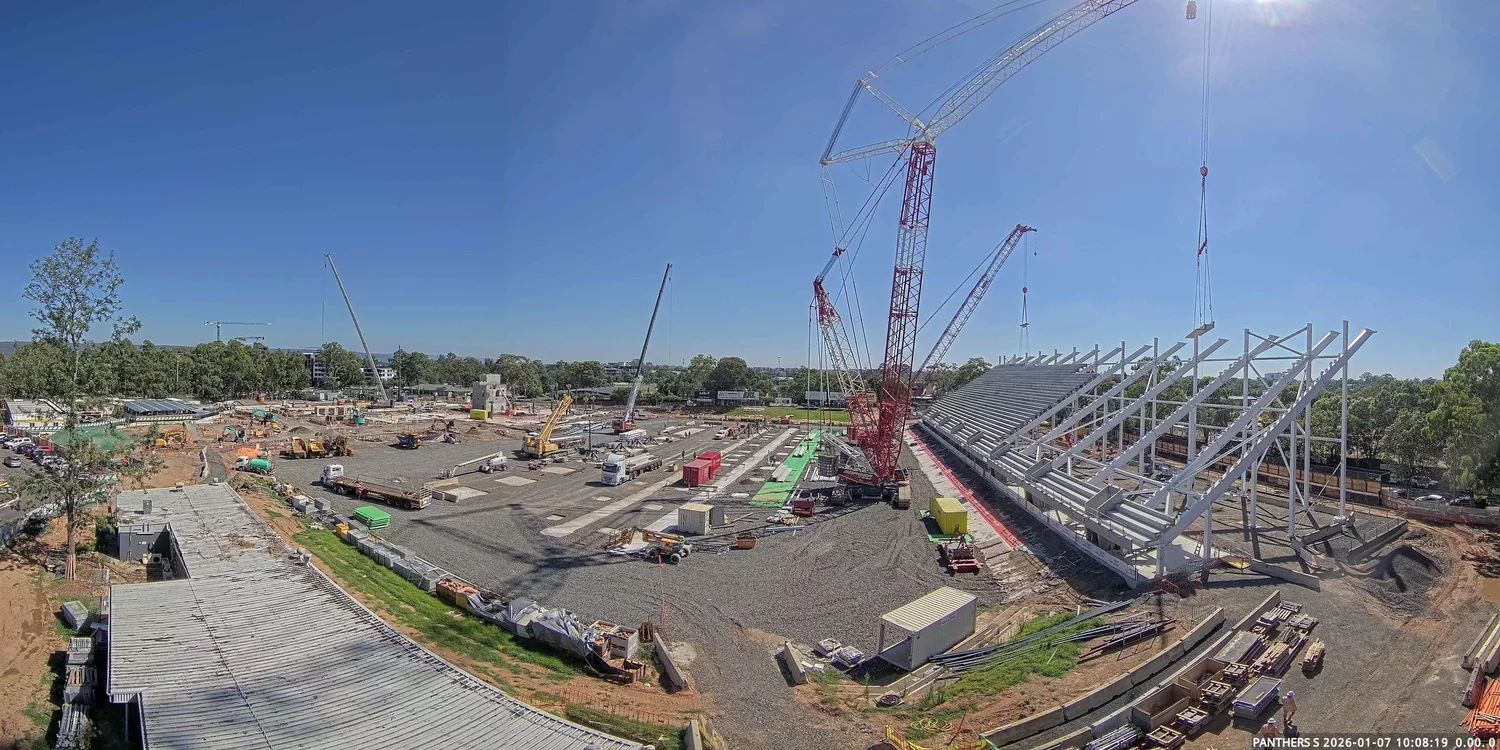
Penrith Stadium Redevelopment
John Holland Precast installation
Remote suspended-load control supported more repeatable panel orientation, reduced manual load intervention and improved lift-cycle consistency during the stadium redevelopment.
The Documented Application
- Project
- Penrith Stadium Redevelopment
- Principal Contractor
- John Holland
- Project Value
- $309 million
- Technology
- Vita Load Navigator
- Application
- Repetitive precast placement
- Reported Result
- Improved placement rate and orientation consistency
Project outcomes shown are based on information supplied to Erne Lifting and published contractor material. Results are specific to this deployment and are not guaranteed on other projects.
VLN in Operation at Penrith Stadium
John Holland’s project video shows the Vita Load Navigator supporting precast installation during construction of the stadium’s eastern grandstand.
The footage provides project context for the lifting operation. Statements within the LinkedIn publication remain attributed to John Holland and should not be interpreted as guaranteed outcomes for other sites.
View the Original John Holland Post (opens in a new tab)Controlling Repetitive Stadium Lifts
Consistent Precast Presentation
Repeated lifts required precast elements to reach the installation area with a controlled and consistent heading.
Manual tagline input, wind-influenced rotation and waiting for loads to settle could add variation to the lift cycle and position personnel closer to swing paths and pinch points.
Remote Orientation and Assisted Stabilisation
The Vita Load Navigator was incorporated into the lift methodology to provide commanded rotation, position hold and repeatable heading settings from an appropriate line-of-sight operating position.
The VLN supported the crane and lifting teams. It did not replace engineered rigging, exclusion zones, supervision, wind limits or approved lift procedures.
How the Lift Cycle Changed
- Manual tagline input during relevant lift phases
- Waiting for residual load rotation to settle
- Repeated heading correction near placement
- Greater variation between similar lifts
- Remote rotational input
- Stored or repeatable heading settings
- Reduced manual orientation near the load
- More consistent repeated lift cycles
The revised workflow was remotely assisted rather than completely hands-free. All lifting remained subject to the approved methodology and site controls.
Results from the Documented Deployment
Daily Placement Rate
- Reported baseline
- Approximately 8 lifts per day
- Reported with VLN
- Approximately 20 lifts per day!
The supplied project information associated the increase with more repeatable orientation and less time spent waiting for or correcting load heading.
Personnel Positioning
Reduced reliance on manual tagline input created opportunities to position personnel further from the suspended load during suitable lift phases.
Orientation Consistency
Remote rotation and heading memory supported steadier presentation across repeated lifts.
Wind-Influenced Movement
Assisted stabilisation helped manage unwanted rotation while operating within approved crane, lift-plan and project wind limits.
Results are specific to the documented load type, crew, crane configuration, lifting sequence, site conditions and approved methodology. They do not guarantee equivalent outcomes elsewhere.
Supporting Safer Load Management
The principal safety opportunity was reducing the amount of direct manual orientation required close to the suspended load.
More predictable heading control supported clearer personnel positioning and consistent management of swing paths, pinch points and controlled exclusion zones.
Controls That Remained Essential
- Approved lift methodology
- Engineered rigging
- Crane and equipment limits
- Project wind procedures
- Controlled exclusion zones
- Pre-use inspections
- Trained operators
- Site communication protocols
Where VLN May Be Considered
Applications involving repeated orientation, restricted access or delays while suspended loads settle may warrant a technical assessment.
Potential Applications
- Repetitive precast installation
- Structural steel placement
- Façade or modular installation
- Loads requiring repeatable headings
- Restricted placement areas
Assessment Factors
- Load mass, geometry and surface area
- Centre of gravity and lifting points
- Crane capacity and rigging configuration
- Environmental and wind limits
- Project procedures and operator training
-
01
Review the Lift
Discuss the load, crane, sequence and current control method.
-
02
Assess Suitability
Review the rigging interface, site conditions and proposed application.
-
03
Plan a Trial
Where appropriate, agree the trial scope, controls and success criteria.
-
04
Deploy and Support
Coordinate setup, training, commissioning and technical support.
Assess VLN for Your Project
Speak with Erne Lifting about your lifting sequence, load characteristics, site conditions and whether a controlled VLN trial should be considered.
Chapter London Bridge
Central London, United Kingdom
Vita Load Navigator technology supported suspended-load orientation within a constrained urban construction site bordered by live infrastructure and sensitive neighbouring facilities.

- Project Location
- London Bridge, United Kingdom
- Site Environment
- Constrained central London footprint
- Adjacent Infrastructure
- Network Rail and St Thomas’ Hospital
- Technology
- Vita Load Navigator
Suspended-Load Control in a Restricted Urban Corridor
Limited Space and Wind-Influenced Rotation
The project was delivered on a highly constrained footprint with limited laydown space, sensitive neighbouring infrastructure and restricted crane positioning.
Wind effects around surrounding structures could influence suspended-load heading and increase the time required to present loads consistently at the installation point.
Remote Orientation and Assisted Stabilisation
The Vita Load Navigator was used to provide remotely commanded rotation and assisted load stabilisation from an appropriate line-of-sight operating position.
The system supported more controlled load presentation while reducing reliance on direct manual orientation close to the suspended load.
Operational Resilience
The VLN formed one part of the approved lifting methodology and supported the crane and lifting teams within the project’s established operating controls.
Constrained Crane Configuration
Project information describes cranes positioned on engineered steel cantilevers above restricted access areas, requiring closely coordinated lifting operations.
Remote Rotational Control
An authorised operator could command clockwise and counter-clockwise load rotation from a suitable line-of-sight position.
Assisted Stabilisation
Thruster output helped manage unwanted rotation and wind-influenced movement within project-approved operating limits.
Critical-Path Support
More repeatable orientation supported a consistent lifting workflow where space, access and delivery sequencing were tightly controlled.
Project observations are specific to the documented load, crane configuration, site conditions, crew and approved lifting methodology. The VLN did not replace engineered rigging, exclusion zones, lift supervision, crane limits, project wind procedures or authorised site controls.
Planning for a High-Density Construction Interface
Successful deployment depended on integrating the VLN into the complete lifting operation rather than treating it as a standalone control measure.
Key Planning Considerations
- Just-in-time delivery sequencing
- Restricted crane and laydown areas
- Wind conditions around surrounding structures
- Interaction with adjacent infrastructure
- Approved rigging and lifting interfaces
- Controlled exclusion zones
- Trained VLN operators
- Project communication protocols
Assess VLN for Your Next Urban Lift
Speak with Erne Lifting about your load characteristics, crane configuration, access restrictions and whether a controlled VLN trial should be considered.